NR and Inflammaging: A New Way to Think About NAD⁺ *Educational Purposes Only*
For years, the conversation around NAD⁺ has mostly been about energy. NAD⁺ helps our cells produce energy, supports mitochondrial function, and plays an important role in how our cells respond to the stresses of aging.
But we think there may be another part of the story that is even more interesting.
What if one of the most important benefits of nicotinamide riboside—or NR—is its potential effect on chronic inflammation and the aging immune system?
A growing number of randomized human studies are pointing in that direction. Researchers studying NR have found changes in inflammatory signaling, immune-cell activity, oxidative stress, airway inflammation, neuroinflammation, and some of the cellular “alarm systems” involved in chronic inflammation.
This is bigger than any single inflammatory marker. NR may influence the underlying cellular environment that becomes increasingly stressed and inflammatory as we age.
First, What Is NR?
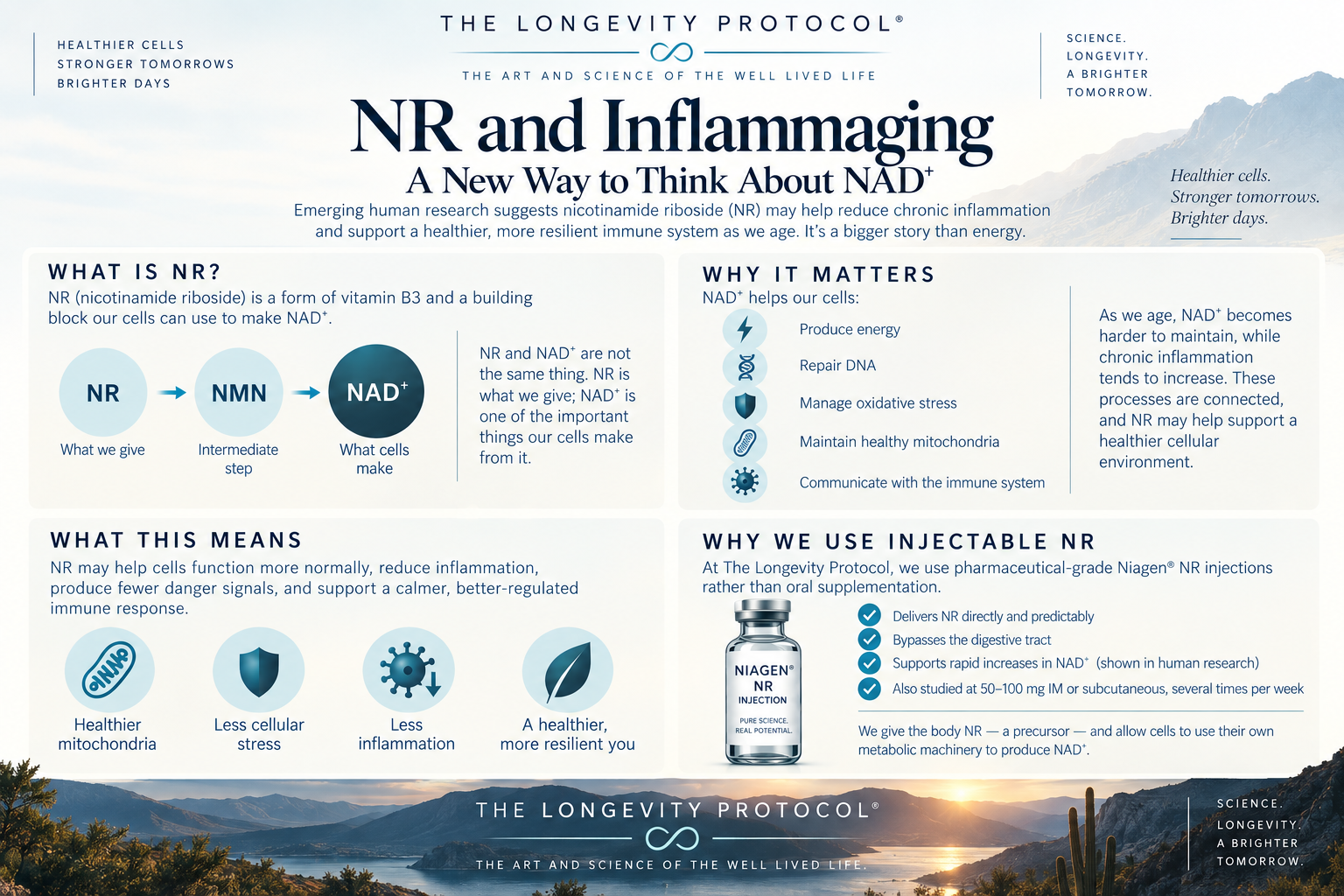
NR stands for nicotinamide riboside. It is a form of vitamin B3 and something our cells can use to make NAD⁺.
Think of NR as a building block:
NR → NMN → NAD⁺
NR and NAD⁺ are therefore not the same thing. NR is what we give; NAD⁺ is one of the important things our cells make from it.
Our cells constantly deal with stress and damage. They need to produce energy, repair DNA, control oxidative stress, maintain healthy mitochondria, and communicate appropriately with the immune system. NAD⁺ participates in all of these processes.
As we age, maintaining healthy NAD⁺ becomes more difficult while chronic inflammation tends to increase. These processes appear to be connected. Inflammation increases the body's demand for NAD⁺, while declining NAD⁺ availability may make cells less capable of handling stress. Mitochondrial dysfunction and oxidative stress can then create additional inflammatory signals.
This can become a cycle:
Cellular stress → inflammation → greater NAD⁺ demand → reduced cellular resilience → more cellular stress and inflammation.
NR may help interrupt this cycle by giving cells the building blocks they need to replenish NAD⁺.
The Problem of “Inflammaging”
There is a name for the chronic, low-grade inflammatory state associated with aging: inflammaging.
This isn't the obvious inflammation of an infection or injured joint. It is quieter—more like an immune system constantly simmering in the background.
Over time, this inflammatory environment is associated with cardiovascular disease, metabolic dysfunction, loss of muscle, frailty, cognitive decline, and neurodegenerative disease.
This is why the NR research has caught our attention. We already have good evidence that NR can increase NAD⁺. The more interesting question is:
What happens to an aging cell—and to the immune system—when we improve its ability to maintain NAD⁺?
Eight Randomized Trials Point Toward an Anti-Inflammatory Effect
Across eight randomized human studies, researchers have observed evidence that NR can influence inflammation or immune function. The populations and outcomes differ, but an interesting pattern emerges when the studies are viewed together.
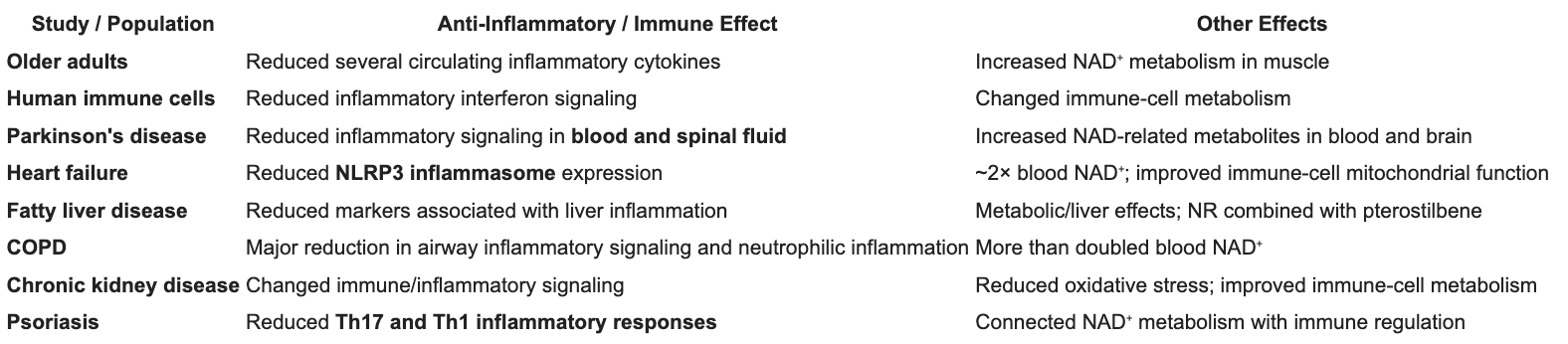
What we find fascinating is the diversity of these findings.
In COPD, NR significantly reduced inflammatory signaling and neutrophilic inflammation directly within the airways. In Parkinson's disease, researchers found inflammatory changes involving both the blood and cerebrospinal fluid.
In heart failure, NR affected the NLRP3 inflammasome, which can be thought of as one of the immune system's cellular alarm systems. When cells sense damage, mitochondrial dysfunction, or metabolic stress, this alarm can promote inflammation. NR was associated with reduced NLRP3 expression while improving mitochondrial function in immune cells.
In psoriasis, researchers demonstrated reduced Th17 and Th1 immune responses, two important drivers of inflammatory and autoimmune activity.
The important point isn't one individual cytokine. The effect appears much broader than that.
The Bigger Picture
When we put the studies together, the findings look like this:
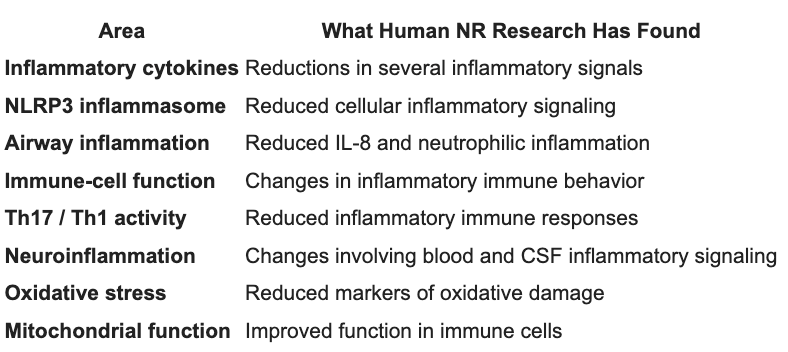
This gives us a simpler way of thinking about NR:
NR provides cells with material to make NAD⁺. Better NAD⁺ availability may help stressed cells and mitochondria function more normally. Healthier cells may produce fewer danger signals, which may contribute to a calmer, better-regulated immune response.
Why We Use Injectable NR

At The Longevity Protocol, we use pharmaceutical-grade Niagen® NR injections rather than relying on oral NR supplementation.
Most of the anti-inflammatory research to date has used oral NR, but injectable NR is now being studied directly in humans.
Human research has evaluated 500 mg of IV NR, demonstrating rapid increases in NAD⁺ and favorable tolerability compared with conventional NAD⁺ infusions. Additional research is studying approximately 50–100 mg of NR given intramuscularly or subcutaneously, including protocols using injections several times per week.
For us, there is an important conceptual difference between NR and simply administering NAD⁺.
NR is a precursor. We give the body NR, and cells use it to produce NAD⁺ through their own metabolic machinery.
Think of it as supplying the raw material rather than simply delivering the finished product. Injections also bypass the digestive tract, giving us another way to deliver NR directly and predictably. This is why we have incorporated pharmaceutical-grade injectable Niagen® NR into our longevity programs.
Maybe NR Is About More Than Energy
This is where we think the NR story becomes much bigger.
Across different populations, NR has been associated with changes in inflammatory signaling, oxidative stress, mitochondrial function, immune-cell metabolism, airway inflammation, neuroinflammation, the NLRP3 inflammasome, and Th1 and Th17 immune activity.
These are different biological systems, but they share a common theme: how cells respond to stress and how the immune system responds to those cells.
We believe longevity medicine has to move beyond simply chasing individual laboratory numbers. Instead of asking only, “How do we lower inflammation?” we should also ask:
Why is the body becoming increasingly inflammatory in the first place?
NR potentially enters this process much further upstream:
NR → more available NAD⁺ → healthier cellular metabolism → better mitochondrial function → better-regulated immune signaling → less chronic inflammatory activity.
That may ultimately be the more important NR story.
We aren't simply interested in suppressing inflammation. We are interested in improving the cellular environment that helps determine whether chronic inflammation develops in the first place.
Perhaps we have been thinking about NR too narrowly. NR may not simply help aging cells produce more energy. It may help them become more resilient, more metabolically capable, and less likely to generate the chronic inflammatory signals associated with aging.
That places NR into a much larger conversation about inflammaging, mitochondrial health, immune resilience, and healthy aging—and into our pursuit of the art and science of living the well lived life.