Does Red Meat Really Age You? The Telomere Data Are Far Less Convincing Than You've Been Told. *Educational Purposes Only*
By Dr. John A. Robinson and Dr. Cristina Romero-Bosch
For years, red meat has been placed on the nutritional list of things we're supposed to fear. Eat more plants. Eat less meat. Avoid saturated fat. And if longevity is your goal, conventional wisdom often suggests that steak should become an occasional indulgence rather than a regular part of your diet.
But when we look at longevity research, we prefer to ask a different question: What does the evidence actually show?
One fascinating place to look is the research on telomeres, the protective structures at the ends of our chromosomes that help maintain genomic stability. Telomeres generally become shorter as cells divide and we age, although genetics, inflammation, oxidative stress, smoking, obesity and metabolic health all influence their length. Telomere length is therefore frequently studied as one marker of biological aging.
If red meat truly accelerates aging, we might expect people who eat more of it to consistently have shorter telomeres. That isn't what the research consistently shows.
The Study That Found the Opposite
One of the most interesting studies was published in Nutrition Journal in 2016 under a revealing title: “The relationship between peripheral blood mononuclear cells telomere length and diet — unexpected effect of red meat.”
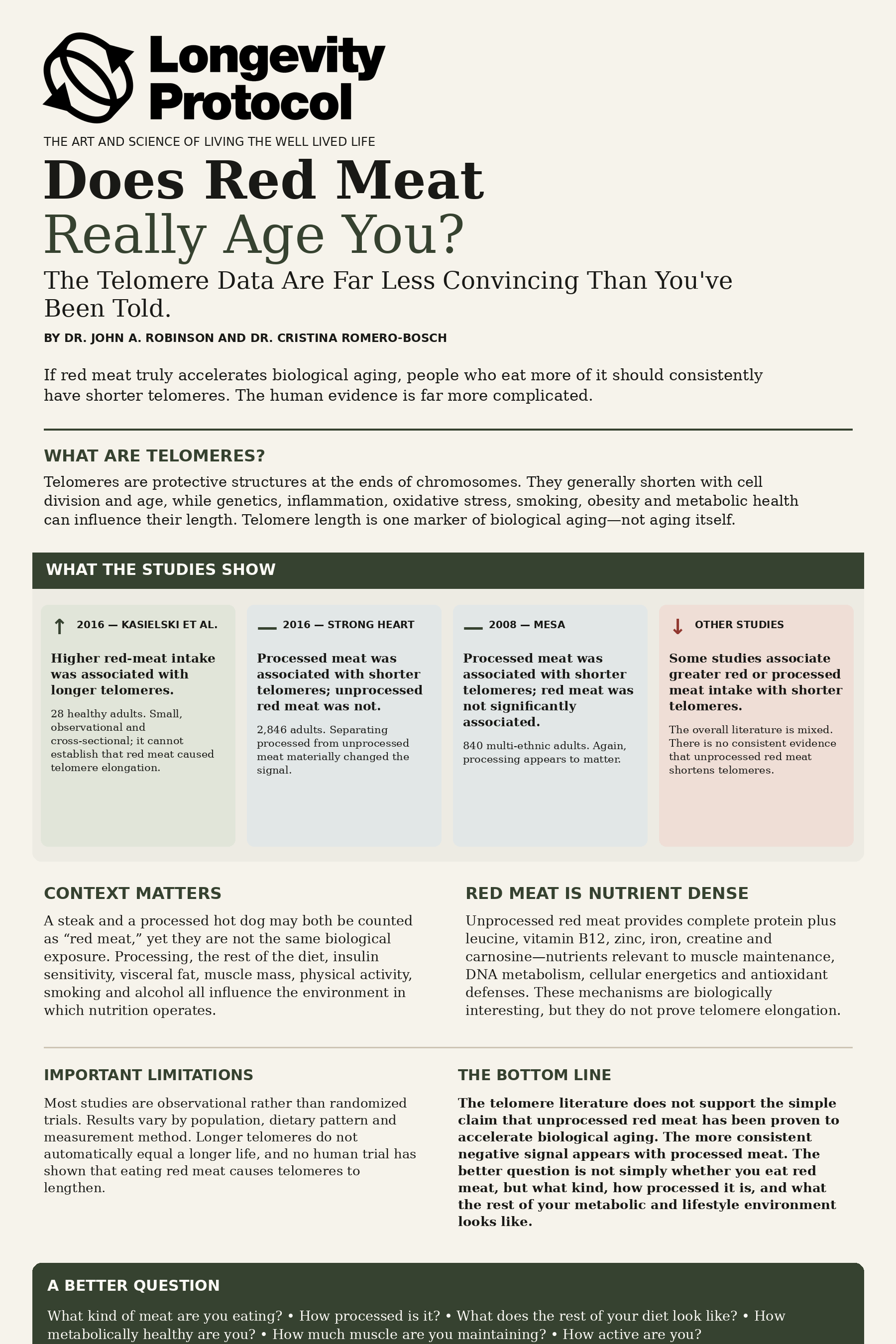
Researchers examined 28 healthy adults and compared telomere length with consumption of numerous foods and beverages. Of the food categories evaluated, red meat was the only one significantly associated with telomere length—and the association went in the opposite direction from what many people would predict. People reporting greater red-meat consumption had, on average, longer telomeres.
This certainly doesn't prove that steak lengthens your telomeres. The study was small, observational and cross-sectional, so we cannot know whether meat caused the difference or whether other characteristics of the participants explain it. But it does challenge the simplistic idea that eating red meat necessarily accelerates cellular aging.
Processed Meat and Red Meat Are Not the Same Thing
A much larger study provides an important clue. The Strong Heart Family Study examined 2,846 adults and, importantly, separated processed meat from unprocessed red meat.
Processed meat consumption was associated with shorter leukocyte telomeres. For every additional daily serving, telomere length was significantly lower. Unprocessed red meat, however, showed no significant association with shorter telomeres. In fact, the statistical estimate pointed slightly toward longer telomeres, although the difference was nowhere near statistical significance.
The Multi-Ethnic Study of Atherosclerosis (MESA) found something remarkably similar. Among 840 adults, processed meat was associated with shorter telomeres, while ordinary red meat was not significantly associated with telomere length.
This raises an important question: Why are we treating a steak and highly processed meat as though they represent the same biological exposure?
The Research Is Mixed—and That's the Point
There are studies showing the opposite relationship as well. Some observational research has associated greater red or processed meat consumption with shorter telomeres, and systematic reviews examining nutrition and telomere health describe a mixed literature.
That's precisely the point. The evidence does not justify saying that red meat lengthens telomeres, but it also doesn't justify confidently stating that eating unprocessed red meat has been demonstrated to shorten telomeres and accelerate biological aging.
The actual science is considerably more complicated.
Maybe “Meat” Is the Wrong Question
At The Longevity Protocol, we believe one of the fundamental problems with nutritional epidemiology is studying individual foods outside the context of the person eating them.
Consider someone who eats steak with vegetables and potatoes after resistance training, maintains significant muscle mass, has excellent insulin sensitivity and consumes little ultra-processed food. Now compare that person with someone eating processed meat on a refined-flour bun with french fries, soda and dessert while living a sedentary lifestyle.
Both may contribute to a research category called “red meat consumption,” but physiologically these are very different exposures.
The metabolic environment matters. Insulin resistance, visceral adiposity, muscle mass, exercise, smoking, alcohol, micronutrient status and the remainder of the diet all matter. And the telomere literature suggests that processing itself may matter considerably.
Red Meat Is Also Nutrient Dense
There is another side of this equation that often disappears from the longevity conversation. Unprocessed red meat provides complete protein along with leucine, vitamin B12, zinc, iron, creatine, carnosine and other nutrients involved in muscle metabolism, cellular energetics and normal physiology.
That becomes increasingly relevant as we age because loss of skeletal muscle—sarcopenia—is itself one of the major threats to healthy aging. Maintaining adequate protein intake and performing resistance exercise become progressively more important with advancing age.
Could nutrient-dense red meat therefore indirectly support cellular resilience through better nutritional status, preservation of muscle and improved metabolic health? It's biologically plausible. Zinc participates in DNA repair and antioxidant systems, B12 is critical for methylation and homocysteine metabolism, creatine supports cellular energy metabolism, and carnosine possesses antioxidant and antiglycation properties.
But we should apply the same scientific standard in both directions: plausibility is not proof. We don't currently have randomized human trials demonstrating that eating steak causes telomeres to lengthen.

Telomeres Aren't the Whole Story
There is another important limitation to this entire discussion: longevity cannot be reduced to a single biomarker. Longer telomeres aren't automatically synonymous with longer life, just as an epigenetic clock, inflammatory marker, cholesterol measurement or biological-age test cannot independently tell us how well someone is aging.
Human aging is a systems problem involving metabolic health, cardiovascular function, muscle, bone, cognition, hormones, immune function, inflammation, mitochondrial health, relationships, purpose and many other factors. That is why we resist turning longevity into a competition to optimize individual numbers while losing sight of the whole person.
So, Does Red Meat Age You?
Based specifically on the telomere literature, we simply don't have strong enough evidence to make that statement. One small human study actually found greater red-meat consumption associated with longer telomeres, while larger studies found no significant adverse association between unprocessed red meat and telomere length. Conversely, processed meat has demonstrated a considerably more consistent negative signal, and some observational studies have associated red meat with shorter telomeres.
The more useful question may therefore not be simply, “Do you eat red meat?” Instead, we should be asking: What kind of meat are you eating, how processed is it, what does the rest of your diet look like, how metabolically healthy are you, how much muscle are you maintaining and how active are you?
At The Longevity Protocol, this is how we prefer to think about nutrition. Foods do not exist in isolation, and neither do human beings. Nutrition operates within a much larger biological environment involving metabolism, muscle, movement, sleep, inflammation and lifestyle.
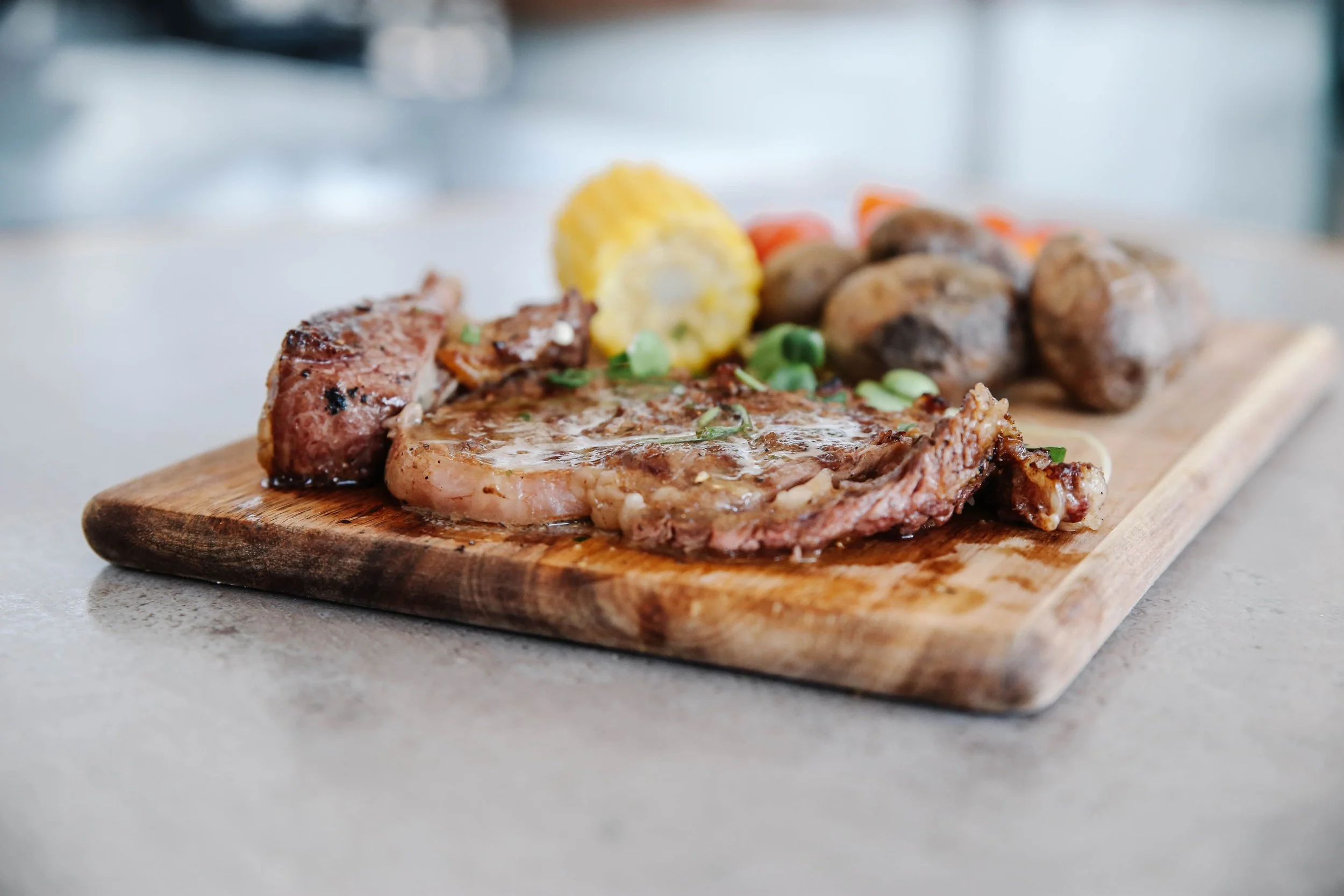
Red meat has not been proven to make us younger, but the telomere literature certainly doesn't support the simple story that eating an unprocessed steak automatically makes us age faster.
Understanding that distinction—and being willing to question overly simplistic nutritional narratives—is part of the art and science of living the well-lived life.
Sources
Kasielski M, Eusebio MO, Pietruczuk M, Nowak D. The relationship between peripheral blood mononuclear cells telomere length and diet — unexpected effect of red meat. Nutrition Journal. 2016;15:68. doi:10.1186/s12937-016-0189-2.
Fretts AM, Howard BV, Siscovick DS, et al. Processed Meat, but Not Unprocessed Red Meat, Is Inversely Associated with Leukocyte Telomere Length in the Strong Heart Family Study. Journal of Nutrition. 2016;146(10):2013–2018. doi:10.3945/jn.116.234922.
Nettleton JA, Diez-Roux A, Jenny NS, Fitzpatrick AL, Jacobs DR Jr. Dietary patterns, food groups, and telomere length in the Multi-Ethnic Study of Atherosclerosis (MESA). American Journal of Clinical Nutrition. 2008;88(5):1405–1412.
Galiè S, Canudas S, Muralidharan J, García-Gavilán J, Bulló M, Salas-Salvadó J. Impact of Nutrition on Telomere Health: Systematic Review of Observational Cohort Studies and Randomized Clinical Trials. Advances in Nutrition. 2020;11(3):576–601.
Rafie N, Golpour Hamedani S, Barak F, et al. Dietary patterns, food groups and telomere length: a systematic review of current studies. European Journal of Clinical Nutrition. 2017;71:151–158.