By Dr. John A. Robinson and Dr. Cristina Romero-Bosch
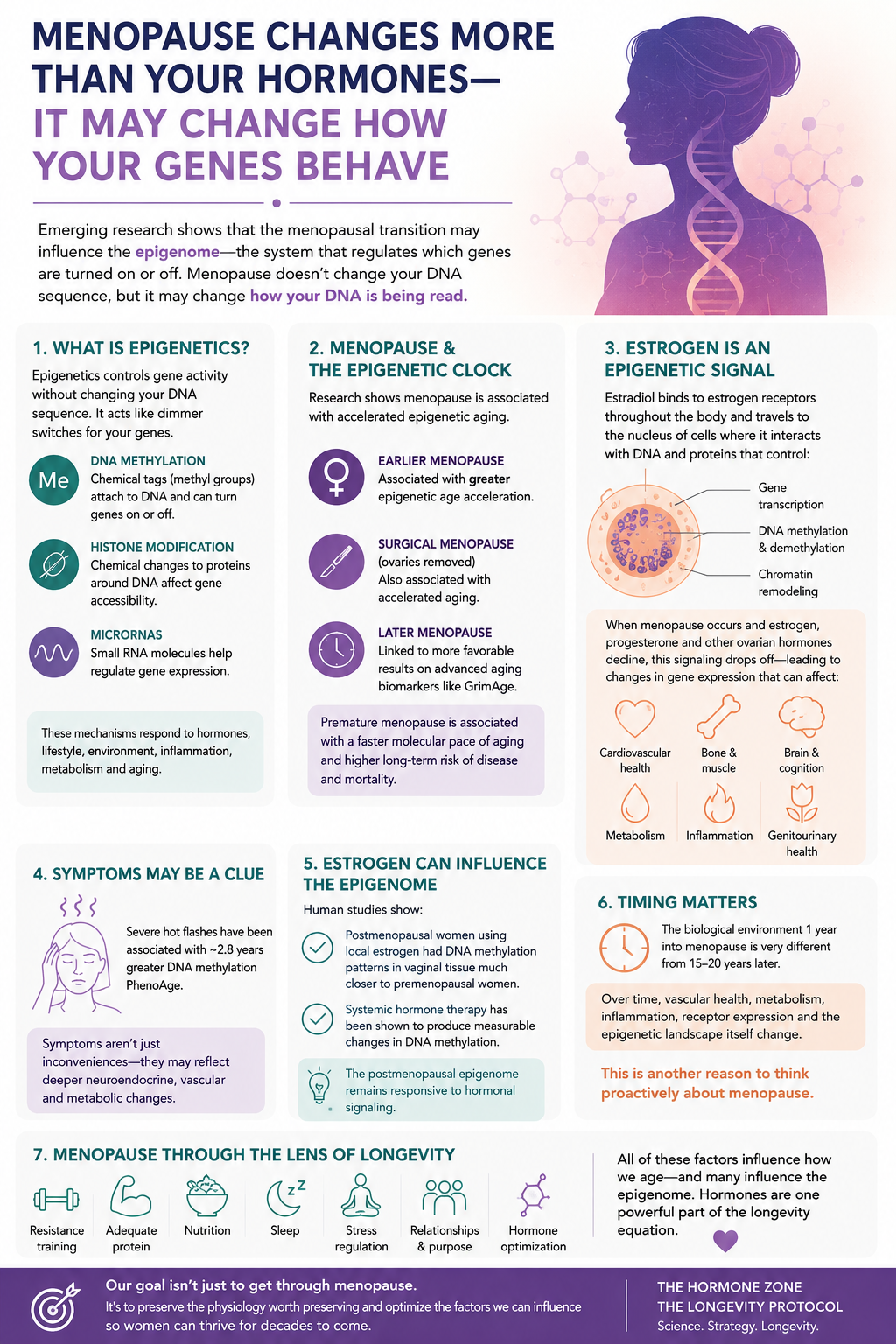
For decades, menopause has been treated primarily as a hormonal event: estrogen declines, periods stop, and women may experience hot flashes, sleep disruption, vaginal dryness, changes in body composition, mood changes and bone loss. But emerging research suggests something much bigger is happening. The menopausal transition may influence how quickly a woman ages at the molecular level, including changes to the epigenome—the biological machinery that helps determine which genes are turned on, which are turned off and how cells ultimately behave. Menopause doesn't change your DNA sequence, but it may change how your DNA is being read.
Menopause and the Epigenetic Clock
Epigenetics refers to mechanisms that regulate gene activity without changing the underlying DNA sequence. One of the best studied is DNA methylation, in which chemical tags influence whether certain genes become more or less active. These patterns change with age and can be used to create "epigenetic clocks" that estimate biological rather than simply chronological aging.
A landmark 2016 study published in Proceedings of the National Academy of Sciences, appropriately titled "Menopause accelerates biological aging," found that earlier menopause was associated with greater epigenetic age acceleration. Surgical menopause through bilateral oophorectomy was also associated with accelerated epigenetic aging. More recent research has strengthened this association. A 2025 analysis found that women who experienced menopause later tended to have more favorable results on GrimAge, an advanced DNA-methylation marker associated with aging and mortality risk. Other research has associated premature menopause with a faster molecular pace of aging.
This doesn't prove that menopause suddenly makes a woman "old," or that estrogen deficiency is the only driver of these changes. It does suggest that reproductive aging and whole-body biological aging are interconnected.
Estrogen Is Also an Epigenetic Signal
This makes sense when we understand what estradiol actually does. Estrogen receptors exist throughout the cardiovascular system, brain, bones, muscles, skin, adipose tissue, genital and urinary tissues and many other areas of the body. When estradiol binds to these receptors, the signal reaches directly into the nucleus, where estrogen receptors interact with DNA, transcription factors and enzymes involved in DNA methylation, demethylation and chromatin regulation. In this sense, estrogen functions partly as an epigenetic regulator.
During menopause, estradiol signaling that has been communicating with tissues for decades falls dramatically. Progesterone disappears even earlier as ovulation becomes irregular, while testosterone and other ovarian hormones also change. This isn't simply a change in laboratory values; it represents a profound change in cellular signaling. Over time, altered hormonal signaling and gene expression may contribute to cardiovascular aging, osteoporosis, sarcopenia, insulin resistance, visceral-fat accumulation, neurocognitive changes, genitourinary aging and chronic inflammation.
Even menopausal symptoms may tell us something about this process. In one study involving more than 1,200 postmenopausal women, severe hot flashes were associated with approximately 2.8 years greater DNA-methylation PhenoAge. That doesn't mean hot flashes cause aging, but significant vasomotor symptoms may sometimes represent an outward manifestation of a much larger neuroendocrine, metabolic and vascular transition occurring underneath the surface.
Can Estrogen Influence the Epigenome?
This may be the most fascinating part of the research. Recent human studies examining postmenopausal vaginal tissue found significant differences in DNA methylation associated with menopause and urogenital atrophy. Women using local estrogen had epigenetic patterns that were considerably closer to those observed in premenopausal women. Systemic menopausal hormone therapy has also been shown to produce measurable changes in DNA methylation.
We cannot yet claim that hormone replacement therapy "reverses epigenetic aging." The science isn't there yet. What we can say is that the postmenopausal epigenome appears to remain responsive to hormonal signaling. This gives us a much more sophisticated way of thinking about hormone therapy: we aren't simply replacing estrogen to stop hot flashes. We are restoring a biological signal that interacts with receptors, transcription factors, chromatin and the machinery regulating gene expression throughout the body.
This research may also help us better understand why timing matters with menopausal hormone therapy. The biological environment of a woman one year into menopause may be very different from that of a woman who has been estrogen deficient for 15 or 20 years. Over time, vascular health, metabolism, inflammation, receptor expression and potentially the epigenetic landscape itself change. This provides another reason to think proactively about menopause rather than waiting decades for age-related disease to develop.
Menopause Through the Lens of Longevity
At The Hormone Zone and The Longevity Protocol, we believe the conversation around menopause needs to become much larger. We certainly care about sleep, sexual health, vaginal and urinary function, mood and hot flashes, but we are equally interested in muscle, bone, brain, cardiovascular health, insulin sensitivity, visceral fat, inflammation and biological aging. Increasingly, epigenetic health belongs in that conversation as well.
Hormone optimization isn't the entire longevity strategy. Resistance training, adequate protein, metabolic health, nutrition, sleep, stress regulation, relationships and purpose all influence how we age, and many of these factors also influence the epigenome. Hormones are one extraordinarily important component of that interconnected system.
Menopause should therefore not simply be viewed as the end of a reproductive chapter. It is a major biological transition deserving proactive attention. Our goal shouldn't be merely to help women "get through menopause." It should be to understand what is changing, preserve the physiology worth preserving and optimize the factors we can influence so women can enter the decades ahead with greater strength, vitality, metabolic health, cognitive function and resilience. Because longevity isn't simply about adding more years—it is about creating the physiology that allows us to keep living the well-lived life throughout them.
Selected Research
Levine ME, Lu AT, Chen BH, et al. Menopause accelerates biological aging. Proceedings of the National Academy of Sciences. 2016;113(33):9327–9332.
Daredia S, et al. Association between age at menopause and epigenetic aging in postmenopausal women. Clinical Epigenetics. 2025.
Menopause and epigenetic changes. Climacteric. 2026.
Menopausal hormone therapy and DNA methylation: Epigenome-wide analyses from the Early versus Late Intervention Trial with Estradiol (ELITE).