Living the Well-Lived Life: Why Longevity Is About Far More Than Living Longer *Educational Purposes Only*
By Dr. John A. Robinson, NMD & Dr. Cristina Romero-Bosch, NMD
The Longevity Protocol™ — The Art and Science of Living the Well-Lived Life
For much of modern medicine, longevity has been measured by a remarkably simple number: how many years did you live? But we have always believed that this is the wrong question—or at least an incomplete one. The better question is: How well did you live those years?
A 2026 scoping review published in the Interactive Journal of Medical Research, titled Enhancing Healthy Longevity: Scoping Review of Practices and Interventions, provides an interesting scientific framework for something we have been developing at The Longevity Protocol for years: longevity is not simply about preventing disease or manipulating biomarkers. It is about preserving the physical, cognitive, emotional, social, and functional capacity that allows us to continue fully participating in our lives.
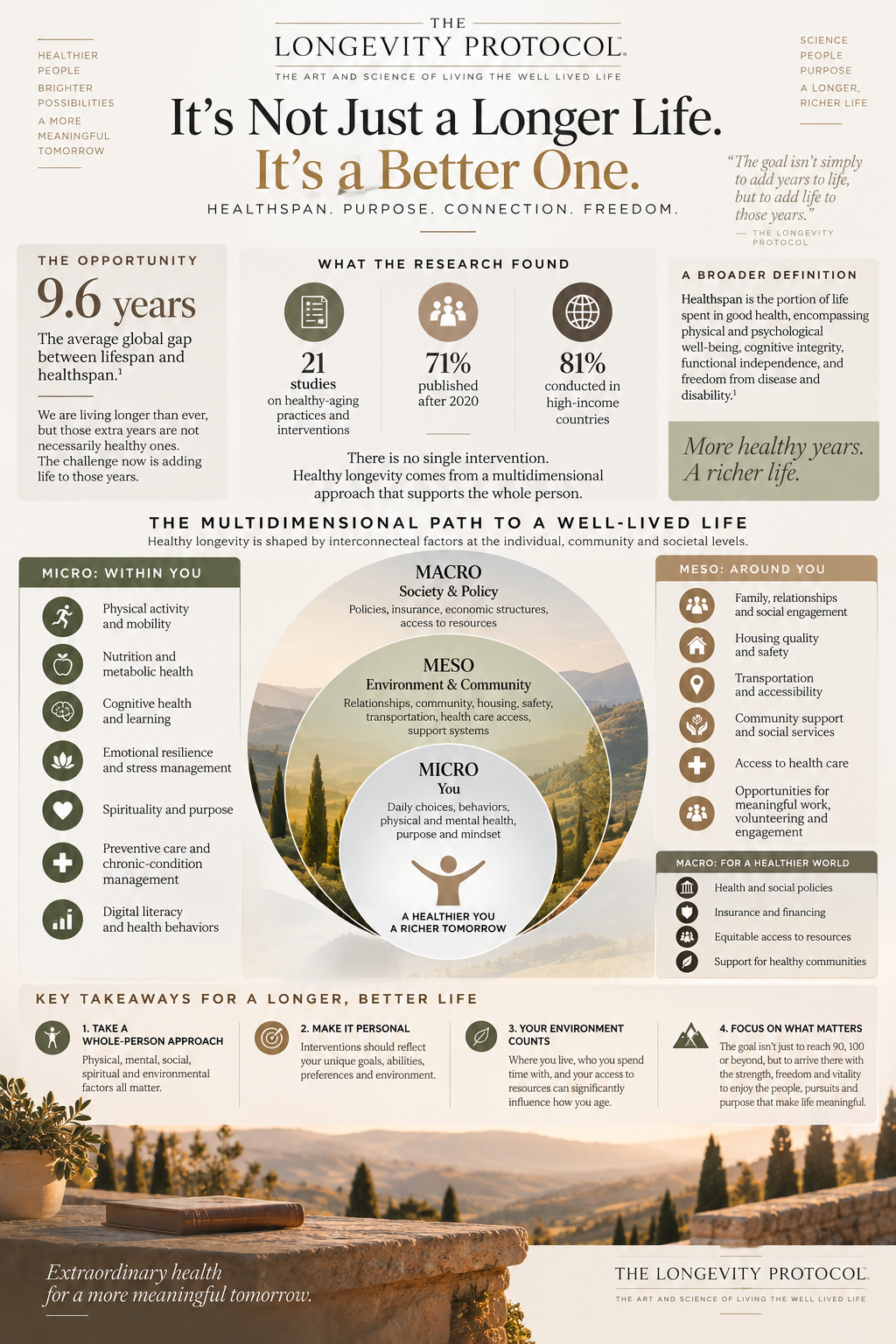
The authors define healthspan as the portion of life spent in good health, encompassing psychological well-being, functional independence, cognitive integrity, and freedom from overt disease and disability. They also point to a growing problem: although humans are living longer, those additional years are not necessarily healthy ones. Across 183 WHO member states, the average gap between lifespan and healthspan has grown to approximately 9.6 years. Medicine has become increasingly successful at adding years to life; the challenge now is adding life to those years.
The Science Is Moving Toward the Whole Person
The researchers reviewed 21 studies examining healthy-aging practices and interventions. What emerged was not a single longevity diet, exercise program, supplement, medication, or biomarker. Instead, the recurring theme was multidimensionality.
Healthy-aging strategies repeatedly incorporated combinations of physical activity, nutrition, cognitive health, emotional management, social connection, preventive health behaviors, spirituality, chronic-condition management, and community engagement. Six of the seven intervention studies incorporated physical activity, but exercise was generally part of a broader strategy rather than the entire strategy.
At The Longevity Protocol, we certainly care about physiology. We want to understand metabolic health, hormones, cardiovascular risk, body composition, inflammation, strength, sleep, cognition, and the biological processes associated with aging. But those measurements are not the destination. They are tools that hopefully allow someone to remain strong enough to travel, cognitively sharp enough to continue creating, sexually healthy enough to maintain intimacy, mobile enough to explore the world, and healthy enough to remain deeply engaged with family and community.
Healthspan Happens in Real Life
One of the most compelling aspects of this review is the authors' division of healthy longevity into micro, meso, and macro factors. The micro level includes what happens within the individual: physical activity, nutrition, cognition, vitality, stress management, spirituality, health behaviors, chronic-condition management, and functional capacity.
The researchers then move outward. The meso level includes relationships, social engagement, community, housing, safety, transportation, access to health care, and support systems. At an even broader level, macro factors include the policies and economic structures influencing access to the resources necessary to age well.
This is remarkably consistent with how we think about the well-lived life. You cannot completely separate the health of a human being from the life that human being is living. Someone can have excellent laboratory values and still be lonely. They can have a favorable biological-age score while having little sense of meaning or purpose. They can optimize nutrition while rarely sitting around a table with people they love. Longevity medicine therefore has to ask a larger question: What are we trying to remain healthy for?
Relationships, Meaning and Spirituality Belong in Longevity
Perhaps most interesting to us is that the review repeatedly identifies factors conventional longevity discussions sometimes treat as peripheral. Social relationships matter. Community matters. Psychological health matters. Spirituality appears among the components identified in both intervention and descriptive research, while support systems, communication, and social engagement repeatedly emerge alongside physical activity and nutrition.
This begins to bridge two conversations that have been unnecessarily separated: the science of extending healthspan and the art of living well. At TLP, we don't believe those are competing ideas. Strength matters because strength gives us freedom. Cognitive health allows us to learn, remember, create, and connect. Sexual health supports intimacy and relationships. Metabolic health gives us the energy to participate in life. Emotional and spiritual health help give that life meaning. The goal isn't simply optimization; the goal is capacity.
Your Environment Is Part of Your Longevity
The review also emphasizes something deserving far more attention in longevity medicine: our environment shapes how we age. The authors discuss the importance of housing quality, neighborhood safety, accessibility, community services, and opportunities for social interaction. They also cite research suggesting environmental factors may account for substantially more variation in mortality risk than genetic predisposition.
This expands the idea of a longevity intervention. Your longevity protocol isn't necessarily limited to what is inside your supplement organizer. It may also include the neighborhood you walk through, the people you eat dinner with, meaningful work, community, and whether your environment encourages movement and engagement rather than isolation.
This is one reason we are increasingly interested in cultures that seem to understand living well intuitively. Food, walking, family, ritual, beauty, conversation, spirituality, community, and purpose may not fit neatly into a traditional medical prescription, but they can profoundly shape the experience of being alive.
From Personalized Medicine to a Personalized Life
The authors ultimately argue that multidomain healthy-aging programs should not become standardized, one-size-fits-all packages. Instead, interventions should reflect an individual's abilities, goals, preferences, culture, and social environment.
We think this is where longevity medicine should be heading. Instead of asking only what intervention might extend lifespan, we should also ask: What kind of life are you trying to preserve? For one person, that may mean skiing at 75. For another, it means maintaining cognition to continue running a company. Someone else wants the energy to travel with their spouse, remain sexually connected, play with grandchildren, write a book, serve their community, or deepen their faith.
That is the philosophy behind The Longevity Protocol™. We want the best science available to help preserve metabolic health, muscle, cognition, cardiovascular function, hormonal health, sexual health, and physical capacity. But those things serve something larger. The objective isn't merely to reach 90, 100, or beyond; it is to arrive there still capable of experiencing the people, pursuits, relationships, meaning, and beauty that make those years worth having.
That is the art and science of living the well-lived life.
Source
Leung AYM, Cheung KSL, Ou K, Zhao IY, Qiu M, Wan KM, Montayre J, Huang Y. Enhancing Healthy Longevity: Scoping Review of Practices and Interventions. Interactive Journal of Medical Research. 2026;15:e94085. doi:10.2196/94085.