For decades, nutrition has been viewed through the lens of calories, weight loss, and disease prevention. While these remain important, the science of longevity is revealing something much more profound. Food is not simply fuel. Food is information.
Every meal sends signals that influence how your genes are expressed, how your cells repair themselves, how much inflammation develops in your body, and ultimately how quickly you age.
At The Longevity Protocol™, we believe longevity is not about living forever. It is about maximizing healthspan—the number of years you remain physically strong, mentally sharp, metabolically healthy, and fully engaged in life. Recent research in the emerging field of epigenetics provides compelling evidence that nutrition may be one of the most powerful tools available to influence that outcome.
Beyond Genetics: Why Your Lifestyle Matters More Than You Think
Most people assume aging is largely predetermined by genetics. While genetics certainly play a role, modern longevity science tells a different story.
Your DNA is the blueprint, but epigenetics determines how that blueprint is read and executed. Epigenetic mechanisms act like switches and dimmers that turn genes on or off in response to environmental inputs. Among all environmental factors, diet appears to be one of the most powerful.
Over time, these epigenetic signals influence inflammation, mitochondrial function, metabolic health, cellular repair, cognitive performance, cardiovascular risk, and disease susceptibility. Scientists can now measure many of these changes through advanced biological age testing known as epigenetic clocks.
The remarkable finding is that biological age and chronological age are not necessarily the same.
Some people age faster than expected. Others age more slowly. The difference often comes down to lifestyle.
The question The Longevity Protocol asks is simple:
What signals are you sending your body every day?
The Diet-Metabolism-Longevity Connection
One of the most important discoveries in longevity research is that nutrients directly influence key molecules involved in aging biology.
Compounds such as:
NAD+
S-adenosylmethionine (SAM)
Alpha-ketoglutarate (α-KG)
Acetyl-CoA
Short-chain fatty acids
act as messengers between nutrition and gene expression.
These molecules regulate inflammation, DNA repair, mitochondrial function, stem cell activity, and cellular resilience. In many ways, they determine whether the body moves toward degeneration or regeneration.
This concept is central to The Longevity Protocol philosophy. We do not simply ask what foods contain certain nutrients. We ask how those nutrients influence the biological systems responsible for aging itself.
Why the Mediterranean Diet Remains the Longevity Gold Standard
Among all dietary patterns studied, the Mediterranean Diet continues to demonstrate the strongest and most consistent association with healthy aging.
This dietary pattern emphasizes:
Extra virgin olive oil
Vegetables
Fruits
Legumes
Nuts and seeds
Fish and seafood
Herbs and spices
Limited processed foods
Minimal refined sugars
The benefits extend far beyond cardiovascular health.
The polyphenols found in olive oil, berries, green tea, cocoa, and colorful plant foods influence gene expression pathways involved in oxidative stress resistance and inflammation control. These compounds help activate protective longevity pathways such as SIRT1, FOXO3, and Nrf2 while reducing chronic inflammatory signaling.
At the same time, the high fiber content of a Mediterranean-style diet nourishes beneficial gut bacteria that produce butyrate and other short-chain fatty acids. These compounds function as powerful signaling molecules that support gut integrity, immune balance, brain health, and healthy aging.
From a longevity perspective, the Mediterranean Diet is not simply a diet. It is an epigenetic intervention.
The Power of Strategic Fasting
One of the foundational principles of The Longevity Protocol is that periods of nutritional abundance should be balanced with periods of nutritional scarcity.
Throughout human history, food was not constantly available. Periodic fasting was normal.
Modern research consistently demonstrates that caloric restriction and fasting activate some of the most important longevity pathways in biology.
These include:
AMPK activation
SIRT1 activation
Autophagy enhancement
mTOR regulation
Improved mitochondrial efficiency
Autophagy is particularly important. Often described as the body's cellular recycling system, autophagy helps remove damaged proteins, dysfunctional mitochondria, and cellular debris that accumulate with age.
This process may represent one of the most important biological mechanisms connecting fasting to healthy aging.
For many individuals, a daily fasting window of 12-16 hours may provide a practical way to engage these pathways while maintaining long-term sustainability.
Ketosis: A Powerful Tool, Not a Permanent Lifestyle
The ketogenic diet has become increasingly popular within longevity circles, and for good reason.
When carbohydrate intake falls sufficiently low, the liver produces ketones, particularly beta-hydroxybutyrate (BHB). Far more than an alternative fuel source, BHB functions as a powerful signaling molecule capable of influencing gene expression.
Research suggests BHB may:
Reduce inflammation
Improve mitochondrial performance
Support cognitive function
Enhance cellular stress resistance
Activate protective longevity pathways
However, longevity science also teaches us an important lesson: more is not always better.
Emerging evidence suggests that prolonged, uninterrupted ketosis may eventually trigger unwanted inflammatory and senescence-related pathways.
For this reason, The Longevity Protocol generally favors metabolic flexibility over dietary extremism. Strategic periods of ketosis, fasting, and carbohydrate restriction may offer substantial benefits without requiring permanent adherence to a ketogenic lifestyle.
The goal is resilience, not rigidity.
The Longevity Protocol™ Nutritional Longevity Matrix
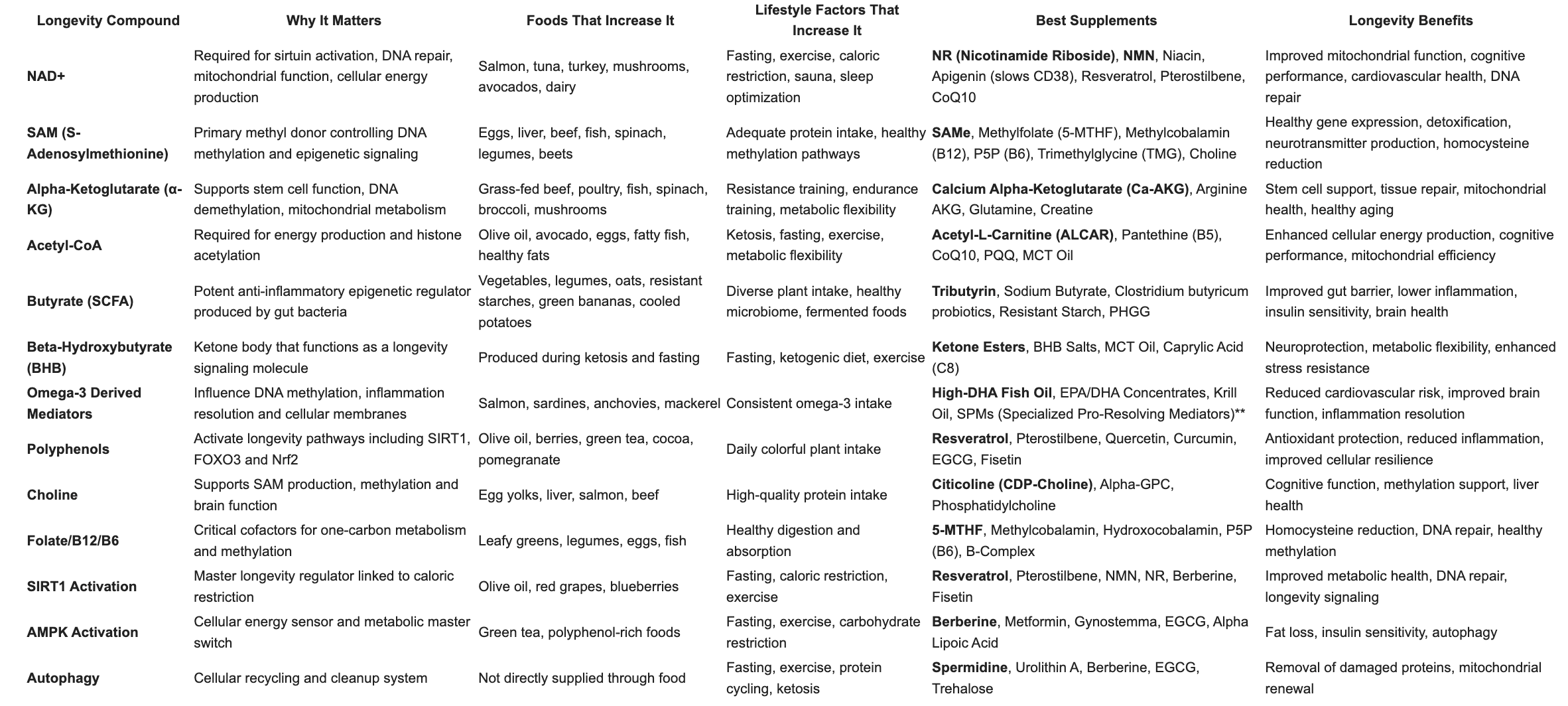
The Longevity Protocol™ "Big Five" Longevity Molecules
If your goal is to maximize healthspan and influence biological age, focus on optimizing these five compounds first:
1 NAD+Fish, dairy, mushroomsNR or NMN + Apigenin
2 Alpha-KetoglutarateBeef, spinach, mushroomsCa-AKG
3 SAMEggs, liver, leafy greensTMG + Methylfolate + B12
4 ButyrateFiber, legumes, resistant starchTributyrin
5 Beta-HydroxybutyrateProduced by fasting/ketosisC8 MCT Oil or Ketone Esters
The Longevity Protocol™ Clinical Pearl
Most longevity supplements work because they ultimately influence one of four major pathways:
NAD+/Sirtuins → DNA repair and mitochondrial function
AMPK → Energy sensing and metabolic health
mTOR → Growth and nutrient sensing
Autophagy → Cellular cleanup and renewal
Virtually every successful longevity intervention—fasting, exercise, caloric restriction, Mediterranean nutrition, ketosis, rapamycin, metformin, berberine, spermidine, Urolithin A, NR/NMN, and Ca-AKG—works through one or more of these pathways. The foods and supplements above are essentially tools to influence those longevity networks and help slow the biology of aging.
The Longevity Protocol™ Food Pyramid for Cellular Rejuvenation
Daily Foundation
Extra Virgin Olive Oil
Colorful Vegetables
Leafy Greens
High-Quality Protein
Omega-3 Rich Fish
Fermented Foods
Supports: SAM, NAD+, Polyphenols, Butyrate
Weekly Longevity Foods
Liver or Organ Meats
Sardines
Wild Salmon
Legumes
Mushrooms
Berries
Green Tea
Supports: NAD+, α-KG, Methylation, Polyphenols
Strategic Interventions
InterventionPrimary Longevity Molecules Activated12-16 Hour FastNAD+, BHB, AMPK24 Hour FastNAD+, BHB, AutophagyResistance Trainingα-KG, NAD+, AMPKZone 2 CardioNAD+, Mitochondrial BiogenesisSaunaNAD+, Heat Shock ProteinsKetogenic PhaseBHB, Acetyl-CoAHigh Fiber DietButyrate
The Longevity Protocol™ Key Concept
Patients often ask:
"What is the best longevity supplement?"
The better question is:
"How do I increase the compounds my body already uses to regulate aging?"
The science reviewed in this paper suggests that the most powerful nutritional longevity strategy is to consistently elevate:
NAD+ → DNA repair and mitochondrial health
SAM → Healthy epigenetic signaling
Alpha-Ketoglutarate → Stem cell support and cellular renewal
Butyrate → Gut and immune health
Beta-Hydroxybutyrate → Metabolic flexibility and stress resistance
These five compounds may represent the nutritional foundation of biological age optimization and are directly influenced by the foods we eat, the timing of our meals, and the lifestyle choices we make every day.
Living the Well Lived Life™
At The Longevity Protocol, we believe longevity is not merely about adding years to life. It is about adding life to years.
The science of epigenetics reinforces what many of us have suspected for years: the choices we make every day matter. The food we eat, the periods we fast, the quality of our nutrition, and the health of our microbiome all contribute to the biological signals that shape our future.
The goal is not perfection.
The goal is to consistently create an internal environment that supports regeneration rather than decline.
Because longevity is not a destination.
It is a daily practice.
And this is your Protocol for Living the Well Lived Life™.
Sources
Zhang X, Xie Z, Bian H, Li Y, Zhu R, Sun J. Dietary Interventions for Healthy Aging: An Epigenetic Perspective. Aging and Disease. Early Access April 2026.
Additional foundational references discussed within the review:
Horvath S, Raj K. DNA methylation-based biomarkers and the epigenetic clock theory of ageing.
Hu FB. Diet strategies for promoting healthy aging and longevity: an epidemiological perspective.
Kuo PL et al. Longitudinal changes in epigenetic clocks predict survival.
Wang K et al. Epigenetic regulation of aging: implications for interventions of aging and diseases.
Chini EN et al. Evolving concepts in NAD+ metabolism.
Zhou DD et al. Effects and Mechanisms of Resveratrol on Aging and Age-Related Diseases.