Few foods have suffered a greater fall from grace than the hot dog.
For decades, we've been told that hot dogs are processed, unhealthy, and something to avoid if we care about longevity. Yet when we step back and examine the traditional origins of sausages through the lens of Weston A. Price and Catherine Shanahan's Deep Nutrition, a fascinating contradiction emerges.
The traditional hot dog wasn't created by food scientists. It wasn't engineered in a laboratory. It was developed by farmers, butchers, and families who understood that every part of an animal possessed value.
In many ways, the traditional sausage represents one of humanity's oldest examples of sustainable, nutrient-dense eating.
The Wisdom of Nose-to-Tail Nutrition
One of the most important observations made by Weston A. Price during his travels was that healthy traditional cultures rarely consumed only muscle meat. They prized organ meats, blood, connective tissue, skin, cartilage, marrow, and fat. These nutrient-dense foods were often reserved for pregnant women, growing children, hunters, tribal leaders, and elders.
Modern society does the opposite.
Today, we consume chicken breasts, filet mignon, and lean ground beef while discarding many of the most nutrient-rich portions of the animal.
Traditional sausage making developed as a solution to this problem. Rather than wasting valuable tissues, cultures throughout Europe transformed them into nutrient-dense foods that could be preserved, transported, and enjoyed year-round.
From an ancestral perspective, the hot dog isn't junk food at all. It is one of the earliest examples of nose-to-tail eating.
Germany's Forgotten Superfoods
Many of the most nutrient-dense sausages ever created originated in Germany.
Long before anyone counted calories, German butchers understood that different tissues provided different nutritional benefits.
Blutwurst (Blood Sausage)
Traditional Blutwurst incorporated blood, liver, fat, skin, and meat trimmings.
This provided remarkable concentrations of:
Iron
Vitamin B12
Vitamin A
Copper
Zinc
Selenium
From a nutrient-density standpoint, Blutwurst may be one of the richest foods in European culinary history.
Leberwurst (Liver Sausage)
Traditional Leberwurst often contained liver, heart, kidney, pork, and fat.
These organs supply:
Vitamin A
Folate
Choline
CoQ10
B vitamins
Iron
Many nutritionists describe liver as nature's multivitamin. Leberwurst simply made it more accessible and enjoyable.
Presssack
Perhaps the ultimate example of nose-to-tail eating, Presssack frequently contained head meat, skin, blood, liver, heart, tongue, and connective tissue.
This was not a food created from leftovers.
It was a food created from respect for the entire animal.
Schwartenmagen
Made from skin, tongue, snout, ears, and connective tissues, Schwartenmagen was naturally rich in collagen, glycine, elastin, and structural proteins that modern diets often lack.
Ironically, these same compounds are now sold as expensive collagen supplements.
Why Modern Nutrition Gets the Story Wrong
Most criticism of hot dogs focuses on sodium, saturated fat, and processing.
Yet this perspective misses an important question:
What if the traditional sausage was actually delivering nutrients that modern diets desperately need?
Many of the compounds associated with healthy aging are abundant in traditional sausages:
Glycine
Collagen
Choline
CoQ10
Vitamin B12
Heme iron
Zinc
Selenium
Fat-soluble vitamins
These nutrients support everything from mitochondrial function and hormone production to joint health, skin integrity, cardiovascular health, and cognitive performance.
The Anatomy of an Ancestral Hot Dog
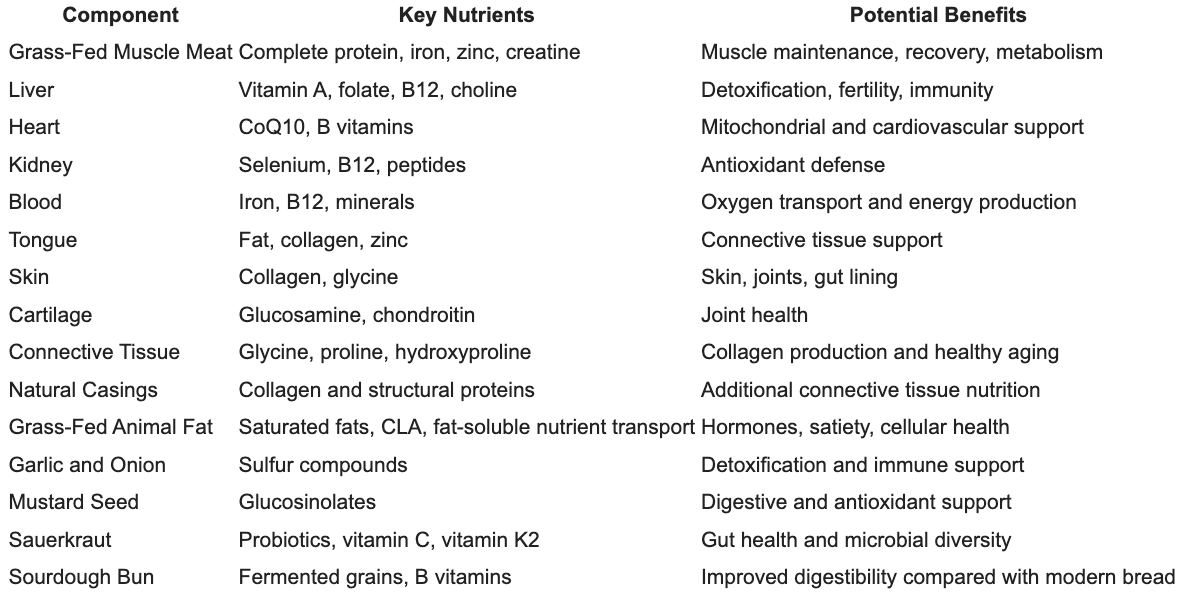
A truly traditional hot dog made from healthy pasture-raised animals contains an impressive collection of nutrients.
Why Grass-Fed Matters
Weston Price repeatedly documented that animal health directly influenced human health.
Animals raised on healthy pasture contain:
More omega-3 fats
Higher CLA levels
More vitamin E
More beta-carotene
Better fatty acid balance
Healthy soil creates healthy plants.
Healthy plants create healthy animals.
Healthy animals create healthy humans.
This concept forms the foundation of both ancestral nutrition and regenerative agriculture.
The Forgotten Importance of Glycine
One of the most interesting concepts in Deep Nutrition is the idea that modern humans consume too much muscle meat and not enough connective tissue.
Muscle meat is rich in methionine.
Traditional foods like sausage, broth, skin, tendons, cartilage, and collagen are rich in glycine.
For thousands of years humans consumed both together.
Today, most people consume the methionine but leave the glycine behind.
Traditional sausages naturally restore that balance.
This may be one reason why cultures consuming nose-to-tail diets historically demonstrated remarkable resilience and lower rates of degenerative disease.
Reimagining the Hot Dog
Imagine a hot dog made from:
Grass-fed beef
Liver
Heart
Kidney
Natural casings
Traditional spices
Fermented sauerkraut
Stone-ground mustard
Sourdough bread
Suddenly the hot dog begins to look less like fast food and more like an ancestral superfood.
The problem was never the sausage itself.
The problem was the industrialization of food.
When we replace pasture-raised animals with feedlot livestock, traditional ingredients with artificial additives, and fermented foods with processed condiments, we lose the nutritional wisdom that made these foods valuable in the first place.
The Longevity Protocol Perspective
At The Longevity Protocol, we often remind patients that health is rarely found in extremes.
The goal is not to eliminate foods that our ancestors thrived on.
The goal is to identify the foods that supported human health for generations and restore them to their rightful place in the modern diet.
Viewed through that lens, the traditional German sausage may be one of the most misunderstood foods in nutrition.
Far from being junk food, it represents a time-tested example of nutrient density, sustainability, nose-to-tail nutrition, and respect for the entire animal. It is a reminder that some of the most powerful longevity foods are not the newest foods on the market—they are the foods our ancestors have been eating all along.