Designing the Second Half of Life with Intention, Purpose, and Joy
"Longevity without meaning is just more time. The question is not how many years you have — it is how fully you will inhabit them." — Barbara Waxman
Who She Is
Barbara Waxman stands at a distinctive intersection in the longevity conversation — not as a clinician measuring biomarkers, not as a biotechnologist extending lifespan, but as someone asking the question that ultimately gives all the others their meaning:
What are the extra years for?
As an advisor to the Stanford Center on Longevity, faculty at the Modern Elder Academy, and one of the most thoughtful voices in what might be called the human architecture of aging, Waxman has spent her career arguing that the greatest longevity intervention is not a supplement, a hormone, or a protocol.
It is a well-designed life.
Her framework — the Longevity LifePlan™, anchored by the Seven Lifestyle Levers™ Assessment — offers something increasingly rare in the longevity space: a serious, evidence-informed, deeply human approach to the question of how we want to live, not merely how long.
The Three Generations of Longevity
Waxman frames the evolution of longevity thinking across three historical stages — a framework that helps locate where The Longevity Protocol™ fits within the broader cultural conversation.
First Generation: Live Longer
The great achievement of 20th-century medicine.
Sanitation, vaccines, antibiotics, surgical intervention, and emergency care dramatically extended the average human lifespan. The question was simple and urgent: how do we keep people alive?
Second Generation: Live Healthier
The healthspan movement.
Exercise, nutrition, sleep, metabolic health, prevention, and early detection. The question evolved: how do we add life to years, not merely years to life?
This is the space where most longevity medicine currently operates — and where much of The Longevity Protocol™ lives in its clinical dimension.
Third Generation: Live More Fully
Waxman calls this the Third Span™ — and it is here that her most important contribution lies.
The question becomes:
"How fully will you inhabit the years you have?"
Cholesterol, glucose, VO₂ max, and epigenetic age matter enormously — but they are instruments in service of something larger. The Third Span asks what that larger thing actually is. It insists that meaning, purpose, relationships, contribution, and joy are not soft additions to a longevity protocol. They are its destination.
The Longevity Protocol™ is committed to all three generations simultaneously — the biology, the healthspan, and the fullness of life that gives both their purpose.
The Seven Lifestyle Levers™
Waxman's assessment framework evaluates seven domains that together shape both healthspan and fulfillment. What is notable is not simply what she includes, but how she frames each one — not as a metric to optimize but as a dimension of a life worth living.
Movement — The Foundation of Freedom
Not merely exercise as calorie expenditure or cardiovascular maintenance, but movement as the basis of independence, confidence, and continued engagement with life.
The question is not just: How much do you exercise? It is: Does your body allow you to inhabit the life you want to live?
Nutrition — Nourishment, Not Optimization Theater
Waxman deliberately resists the trap of nutritional perfectionism — the endless pursuit of the optimal diet that paradoxically undermines the pleasure and social richness of eating.
Her emphasis: nourishment that sustains energy, vitality, and enjoyment — fitted to the individual's actual life.
This resonates with our own clinical philosophy: the best nutritional protocol is one the patient can sustain, enjoy, and share with others.
Sleep — The Regenerative Foundation
Sleep as the pillar beneath every other pillar — affecting cognition, emotional regulation, metabolic health, immune function, hormonal balance, and resilience.
Not a luxury. A biological necessity and a non-negotiable foundation of the well-lived life.
Cognitive Health — The Growing Brain
Lifelong learning. Curiosity. Adaptability. Creative engagement.
The brain was not designed to stop growing at 30. Cognitive reserve — built through intellectual challenge, novelty, social engagement, and purposeful activity — is one of the most powerful protective factors against dementia.
The brain that keeps learning keeps living.
Relationships — Longevity Is Social
Perhaps Waxman's strongest and most consistent emphasis.
The Harvard Study of Adult Development — the longest longitudinal study of human flourishing ever conducted — found that the quality of relationships at midlife was the single strongest predictor of health and happiness in later life. Not wealth. Not status. Not even health behaviors.
Relationships.
Waxman insists that longevity is fundamentally social — that isolation is as dangerous as smoking, and that the cultivation of genuine connection is a clinical priority, not a lifestyle preference.
In The Longevity Protocol™, social and relational health is not a footnote. It is a pillar.
Purpose — The Direction That Organizes Everything Else
Purpose, in Waxman's framework, is not a destination but a compass — the organizing principle that gives direction to every other health behavior.
People with strong purpose:
Exercise more consistently
Recover more effectively from illness and setback
Experience less depression and anxiety
Remain socially engaged
Live measurably longer
Purpose is not a luxury of the spiritually inclined. It is a biological imperative — mediated through cortisol regulation, immune function, behavioral consistency, and the will to continue.
Stress Resilience — Responding Rather Than Reacting
Not the elimination of stress — which is neither possible nor desirable — but the cultivation of resilience: the capacity to meet life's inevitable challenges with flexibility, wisdom, and recovery.
Waxman's coaching emphasizes the difference between reacting to difficulty and responding to it — a distinction with profound biological consequences for inflammation, hormonal balance, and long-term health.
The Longevity LifePlan™: Four Organizing Questions
After assessing the Seven Levers, Waxman helps individuals build a personalized life-design roadmap around four questions that are deceptively simple and profoundly demanding:
Who am I becoming?
Identity. Not who I have been, but who I am in the process of becoming.
How does aging become a period of expansion, growth, and increasing authenticity — rather than a slow subtraction of the person I once was?
What matters most?
Values. Before pursuing longevity, clarify what additional years are meant to accomplish.
More time for what? More energy for whom? More life in service of which vision?
How do I spend my energy?
Not merely time management — energy management.
The question is not how to fit more into the day, but how to design a life around activities, relationships, and commitments that generate vitality rather than depletion.
How do today's choices create tomorrow's life?
The most quietly powerful of the four questions.
"Are today's habits creating the person you hope to become twenty years from now?"
This is the compound interest of the well-lived life — small, consistent, intentional choices that accumulate over decades into a person, a character, and a life.
Middlescence® — Midlife as Beginning, Not Ending
One of Waxman's most culturally significant contributions is her reframing of midlife through the concept of Middlescence®.
Just as adolescence is a developmental stage characterized by:
Identity reassessment
Role transition
Expanded possibility
Occasional turbulence and confusion
...so too is midlife — the 40s, 50s, and 60s — a developmental stage rather than a period of decline.
The midlife "crisis" is, in Waxman's framework, actually a midlife invitation — an opportunity to shed identities that no longer fit, to clarify what truly matters, and to begin the most authentic and purposeful chapter of one's life.
This reframing has significant clinical implications. Patients who understand midlife as a beginning rather than an ending approach hormonal changes, physical transitions, and life restructuring with curiosity and agency rather than grief and resignation.
This is the population The Longevity Protocol™ serves — and Waxman's framework helps explain why they are often our most motivated, most transformed, and most grateful patients.
Convergence: Where Our Philosophies Meet
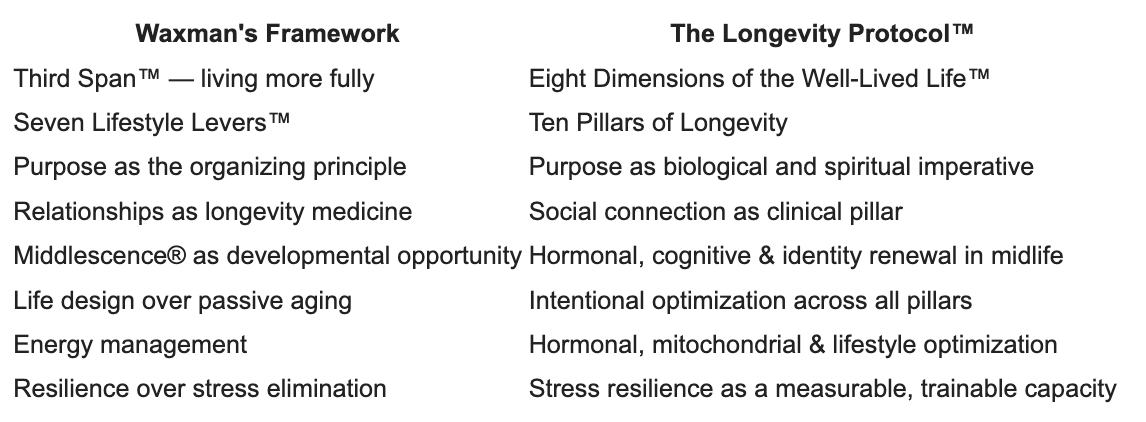
Where The Longevity Protocol™ Extends the Conversation
Barbara Waxman's contribution is irreplaceable — and we receive it with genuine respect. Her insistence that life design matters as much as biomarkers is a corrective the longevity field needs urgently.
The Longevity Protocol™ seeks to carry that conviction further by integrating:
Precision biology — epigenetic clocks, advanced diagnostics, hormonal optimization, regenerative medicine, and measurable biomarkers that make flourishing not merely aspirational but trackable and actionable
The Western philosophical tradition — from Aristotle's eudaimonia and the Stoic ars vivendi to the Christian theology of the body, which offers the deepest account of why human flourishing matters and what it is ultimately for
Spiritual formation — the conviction, rooted in Catholic anthropology, that the human person is not merely a biological organism to be optimized but an immortal soul called to love, to serve, and to become — and that this calling is itself a longevity intervention of the highest order
Cross-cultural synthesis — hygge, sobremesa, kefi, ikigai, lagom and the global convergence of traditions that have always known, in their bones, what science is now confirming in peer-reviewed journals
Clinical accountability — the discipline of measurement, tracking, and evidence-based intervention that ensures the philosophy of flourishing is not merely beautiful but effective
A Genuine Dialogue
Waxman asks: How fully will you inhabit your years?
McGarey asks: How do we support life rather than merely fight disease?
The Longevity Protocol™ asks both — and adds a third:
What does it mean to live as you were made to live — biologically, relationally, spiritually, and fully — and how do we build the science, the philosophy, and the daily practice to make that possible?
These are not competing questions.
They are a conversation — one that medicine is only beginning to have seriously, and one that we are honored to be part of.
"The goal is not to add years to your life, but to add life to your years — and then, perhaps, discover that the two were never as separate as we thought."
© The Longevity Protocol™ | Dr. Robinson & Dr. Romero-Bosch